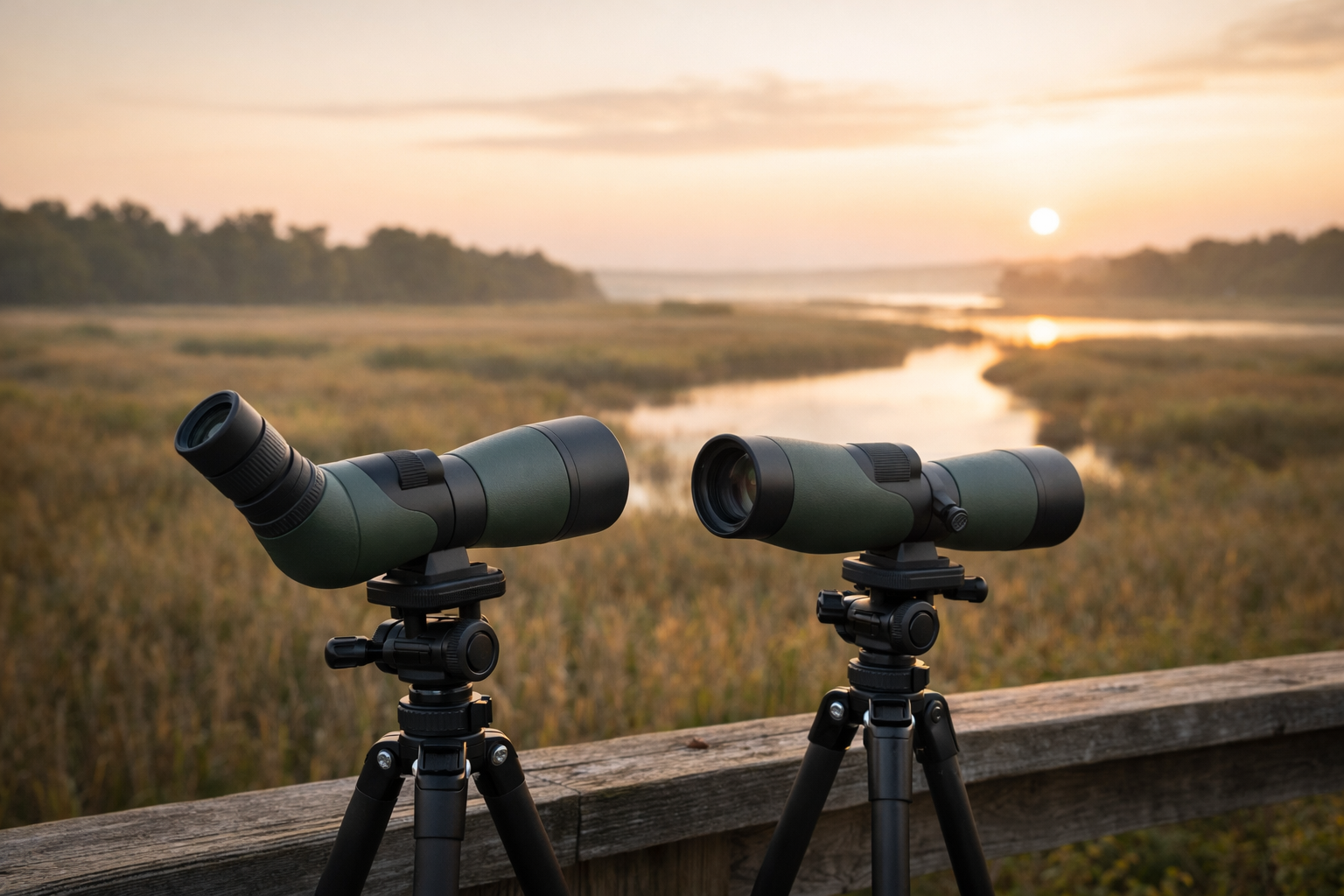
If you’re shopping for a spotting scope, one of the first choices you’ll run into has nothing to do with glass quality, magnification, or price.
It’s the body style.
Do you want an angled spotting scope or a straight spotting scope?
This is one of those decisions that seems minor until you actually start using a scope in the field. Then it becomes very obvious, very quickly, that body style can make a real difference in comfort, ease of use, and how well the scope fits the way you actually observe.
Neither style is universally better.
The right choice depends on where you use your scope, how long you spend behind it, whether you’re birding, hunting, or range spotting, and whether you value speed or comfort a little more.
What’s the Difference?
A straight spotting scope has an eyepiece that lines up directly with the body of the scope.
An angled spotting scope has an eyepiece set at an angle, usually around 45 degrees.
That one design difference changes the entire feel of the scope.
A straight scope feels more intuitive right away. You point it more or less the same way you point a finger. A lot of people find it faster to get behind, especially when they’re new to spotting scopes or using one to look at something specific in a hurry.
An angled scope usually takes a little more getting used to, but it often becomes the more comfortable option once you spend serious time behind it.
Why Many People Prefer Angled Spotting Scopes
Angled spotting scopes are incredibly popular for a reason.
The biggest advantage is comfort.
Because the eyepiece sits at an angle, you can use the scope from a lower tripod position. That usually means a steadier setup, a more relaxed viewing position, and less fatigue during long glassing sessions. If you spend a lot of time scanning shorelines, mudflats, open fields, ridges, or distant tree lines, that matters.
An angled scope can also be easier when more than one person is using it. Instead of constantly raising and lowering the tripod for different heights, people can often share the same setup with fewer adjustments.
That makes angled scopes especially attractive for:
- birding
- hawk watching
- waterfowl scouting
- long observation sessions
- shared use between multiple people
- seated glassing
If you’re the kind of person who tends to spend a long time behind a scope, angled often ends up being the more comfortable choice.
Where Straight Spotting Scopes Still Shine
Straight spotting scopes still have some very real advantages.
The biggest one is speed.
For a lot of people, a straight scope is simply faster to aim. If you’re already looking at something with your eyes or binoculars, it can feel more natural to bring a straight scope onto the target. There’s less of a learning curve, and for some users it just feels more intuitive from the start.
Straight scopes also make a lot of sense in situations where you’re looking more horizontally than upward, or when you’re viewing from a vehicle or window mount. In those situations, the direct line of sight can be very convenient.
That makes straight scopes appealing for:
- range use
- vehicle-based observation
- quick target acquisition
- users who want the simplest aiming experience
- anyone who finds angled scopes awkward
If you already know that you value speed and simplicity over long-session comfort, a straight scope may suit you better.
The Comfort Difference Is Bigger Than People Expect
This is where a lot of buyers get surprised.
When people first compare angled and straight scopes, they often assume the decision is mostly about preference. And yes, personal preference matters. But comfort and tripod setup matter more than many people realize.
A straight spotting scope generally needs to sit closer to eye level. That often means a taller tripod setup, especially for standing use. A taller tripod can be a little less stable, especially in wind or on softer ground.
An angled spotting scope can usually sit lower. That lower setup can feel more stable, more relaxed, and easier to use over time.
That doesn’t mean straight scopes are uncomfortable. It just means that over a long day, especially for birding or extended glassing, angled scopes often have the edge.
Which Style Is Better for Birding?
If we’re talking about general birding, angled spotting scopes usually have the advantage.
Birders often spend long stretches scanning, watching movement, and sharing views. They’re not always trying to get on one target instantly and move on. Comfort, steadiness, and ease of shared use tend to matter a lot.
That’s where angled scopes make a strong case.
They’re often easier for long sessions, easier to use from a seated position, and more forgiving when multiple people are taking turns at the eyepiece.
That said, a straight scope can still be a perfectly good birding tool, especially for someone who really values quick aiming or simply finds that style more natural.
Which Style Is Better for Hunting or Range Use?
This depends a bit more on the user.
For range use or situations where fast target acquisition matters, a straight spotting scope can be a great fit. If you want to get on steel, check an impact, or quickly line up on a specific point, straight often feels very direct.
For hunting, both styles have their place.
If your style of glassing involves sitting for longer periods and picking apart terrain, angled can be excellent. If you want something that feels fast and intuitive, especially when checking a distant animal or moving quickly between points, straight can make a strong case.
A lot of this comes down to how you actually use the scope, not just what category you fall into.
A Few Current Examples from Our Website
To make this more practical, here are a few current examples from our website.
On the angled side, the Vortex Crossfire HD 12-36x50 Angled Spotting Scope is listed at $319.00. It’s a compact, approachable option for someone who wants to get into spotting scopes without going too deep too fast.
The Vortex Crossfire HD 16-48x65 Angled Spotting Scope is listed at $399.00, down from $499.00, and gives you a bit more objective size and magnification without getting overly bulky.
The Vortex Diamondback HD 20-60x85 Angled is listed at $829.00, down from $1,079.00, and is a good example of a larger angled scope for people who want more reach and stronger low-light performance.
If you want something more premium in a compact angled format, the Swarovski ST Balance 14-35x50 is listed at $5,499.00 and is built around portability with high-end optical performance.
For a more premium angled option with stronger mid-size performance, the Vortex Razor HD 22-48x65 Angled is listed at $2,119.00, down from $2,799.00.
On the straight side, the Vortex Diamondback HD 20-60x85 Straight is listed at $829.00 and gives you the same general idea of higher magnification and larger objective size, but in a body style that many users find faster and more intuitive.
The Swarovski ATS-65 HD Spotting Scope (Body Only) is listed at $3,289.00, and the Swarovski ATS-80 HD Spotting Scope (Body Only) is listed at $4,569.00 for buyers who prefer a straight-body premium option.
Pricing is accurate at the time of posting, but please contact us for the most current pricing. On some binoculars and spotting scopes, better pricing may be available if you email, call, or text us.
So Which One Should You Choose?
If you want the simplest version, here it is:
Choose angled if you value comfort, longer viewing sessions, a lower tripod setup, and shared use.
Choose straight if you value quick target acquisition, intuitive aiming, and vehicle or range use.
For a lot of birders and general wildlife observers, angled ends up being the better long-term fit.
For a lot of range users and people who want the fastest possible aiming experience, straight still makes a ton of sense.
The best choice is not the one that wins some imaginary optics debate.
It’s the one that fits the way you actually use your gear.
Final Thoughts
There’s no wrong answer here.
A good angled spotting scope can be incredibly comfortable and versatile. A good straight spotting scope can feel fast, simple, and efficient.
If you’re torn between the two, it helps to think less about specs and more about behaviour.
How do you actually observe?
Do you sit and glass for long periods?
Do you share your scope often?
Do you use it from a vehicle?
Do you want comfort, speed, or a bit of both?
Answer those questions honestly, and the right body style usually becomes a lot clearer.