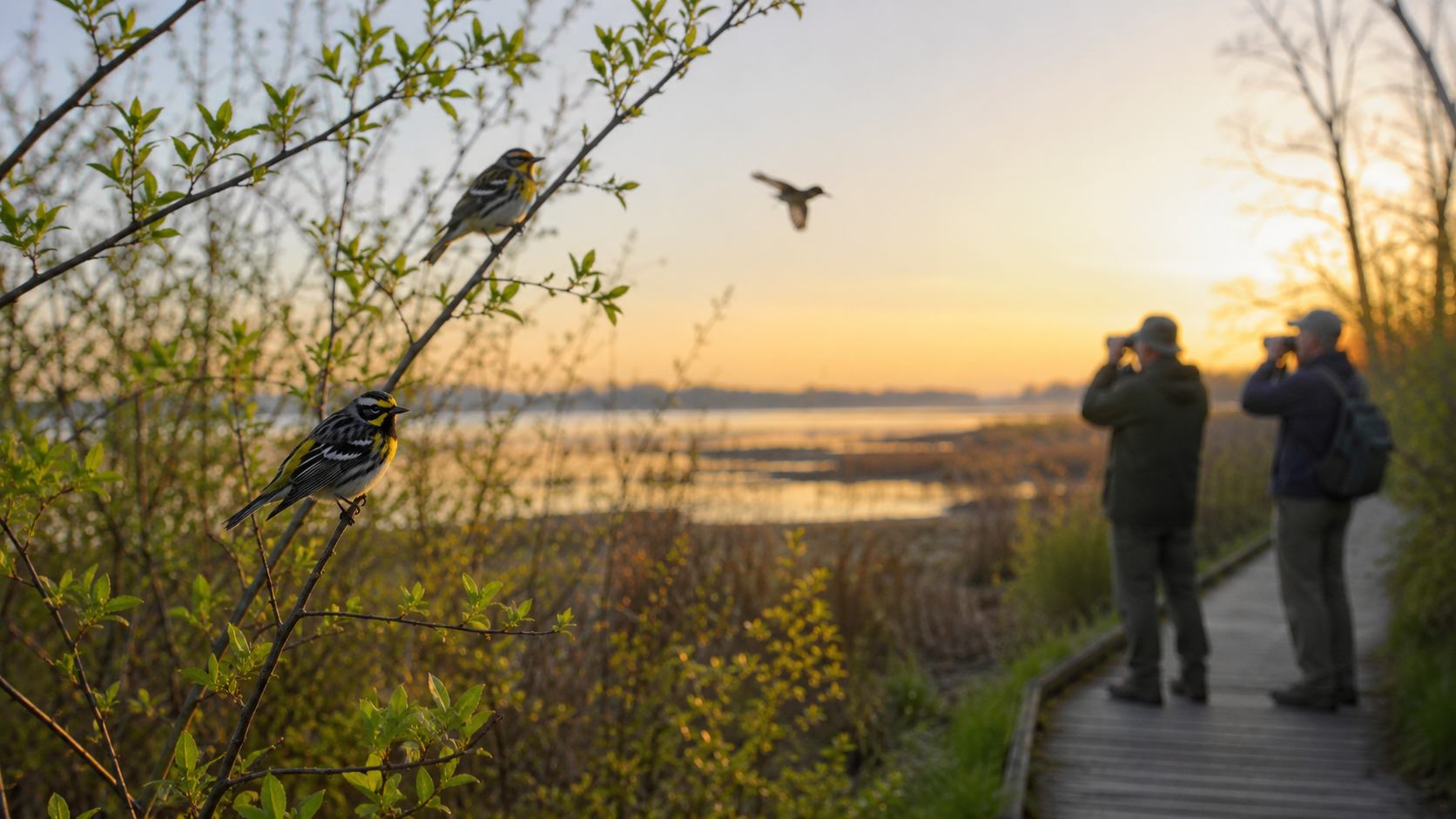
Spring 2026 Bird Migration Report: Point Pelee & Southern Lake Erie
Every spring, Point Pelee National Park and the surrounding Lake Erie shoreline quietly transform into one of the most important migration corridors in North America. If you’ve spent any time here during peak season, you know how quickly things can change—one morning feels still and quiet, and the next the woods are full of movement again.
Spring 2026 followed that familiar rhythm, with strong waves of neotropical migrants, classic weather-driven “fallout” days, and a few standout rarities that added extra excitement throughout the season.
At Pelee Wings Outfitters, we stay closely connected to what’s happening on the ground through daily observations, conversations with visiting birders, and regional reporting networks. What follows is a short summary of how the season unfolded and how it compares to recent years.
Overall Conditions: A Classic Lake Erie Wave Migration Year
Migration in this region is never completely steady. It moves with the weather.
In 2026, that pattern was especially clear. Several overnight systems moved across Lake Erie and delivered birds in distinct waves, followed by quieter stretches where the woods almost seemed to reset before the next arrival.
Key characteristics of the season included:
- Clear migration waves tied to favorable wind and weather conditions
- Strong diversity during peak arrival mornings
- Noticeable quieter periods between movement events
Compared to recent years, 2026 felt more contrast-driven—excellent peak days, but with more separation between those moments.
Peak Migration Period (Late April to Mid-May)
As usual, the main migration window ran from late April through mid-May, with early May producing some of the most consistent activity.
During peak conditions, the experience in the field was often dynamic. You might start a morning walk with a handful of expected early arrivals, and within a short period notice the woods filling in with new movement.
During these windows, birders commonly experienced:
- Steady movement of warblers through woodland edges and interior trails
- Strong morning diversity that often carried well into midday
- Constant turnover as new waves arrived and others moved on
On the best mornings, it wasn’t unusual to record 15–20+ warbler species in a single outing, reflecting the full strength of migration through the Lake Erie corridor.
Notable Species Highlights from Spring 2026
While each spring has its own subtle differences, 2026 delivered a strong and familiar mix of expected migrants:
- Prothonotary Warbler
- Blue-winged Warbler
- Blackpoll Warbler
- Golden-winged Warbler
- Worm-eating Warbler
- White-faced Ibis
- Piping Plover
- A broad range of sparrow species through early and mid-season movement
- Active shorebird presence during transitional weather periods
Taken together, these observations were consistent with a strong overall migration year and steady use of regional habitats across the Lake Erie shoreline.
Weather Influence: The Defining Factor of the Season
As always in the Lake Erie basin, weather set the pace for everything.
In 2026, that influence showed up clearly:
- Overnight winds brought concentrated arrival mornings
- Some days built slowly, then suddenly “turned on” as conditions shifted
- Periodic reverse migration added unpredictability during unsettled systems
There were several mornings where conditions felt quiet at first light, only for bird activity to increase noticeably as the morning progressed. That kind of shift is part of what makes this region so engaging—it rarely stays static for long.
Notable and Unusual Sightings (Spring 2026)
Alongside the expected spring movement, 2026 also produced a handful of sightings that generated a lot of conversation among visiting birders.
Among the most notable were:
- Baikal Teal – a highly uncommon vagrant in North America, and one of those sightings that quickly circulates through the birding community when it appears. (And, as often happens during peak season, not always easy for everyone to connect with in time.)
- White-winged Dove – an uncommon but increasingly regular visitor in southern Ontario, reflecting ongoing range expansion and occasional dispersal beyond its traditional limits.
- Eurasian Collared-Dove – now established in parts of North America, continuing its gradual spread and appearing sporadically as it expands into new areas.
While these weren’t part of the core migration flow, they added an extra layer of unpredictability to the season and reminded us that spring birding here often delivers more than what you’re expecting.
Comparison to Recent Years
Looking at the broader pattern, 2026 fits comfortably within what we expect for the Lake Erie corridor, with a few subtle differences.
Similarities
- Consistent peak timing from late April through mid-May
- Strong overall warbler diversity typical of the region
- Reliable dependence on weather-driven movement
Differences
- More clearly defined wave-based movement patterns
- Greater contrast between peak and quieter days
- A handful of standout mornings with especially high density and diversity
Rather than increasing overall volume, the season was defined more by how clearly the peaks stood out.
What This Means for Birders
If there’s one takeaway from 2026, it’s that timing and flexibility matter just as much as location.
- A single overnight weather system can completely change a morning
- The best diversity often happens in short, concentrated windows
- Multi-day visits consistently provide the best chance of hitting peak movement
Even experienced birders were adjusting plans day-to-day based on wind direction and overnight conditions.
Final Thoughts
Spring 2026 delivered what this region does best: weather-driven migration with moments of exceptional activity, balanced by quieter periods in between.
When conditions lined up, the results were outstanding—and those peak mornings are exactly why Point Pelee continues to be one of the most important birding destinations in North America.
Alongside strong neotropical migration, the occasional unexpected rarity added a sense of unpredictability that keeps each season feeling a little different from the last.
At Pelee Wings Outfitters, we’ll continue tracking these seasonal patterns and sharing insights as they develop. If you’re planning a visit, we’re always happy to help with timing, locations, and optics recommendations based on current conditions.